
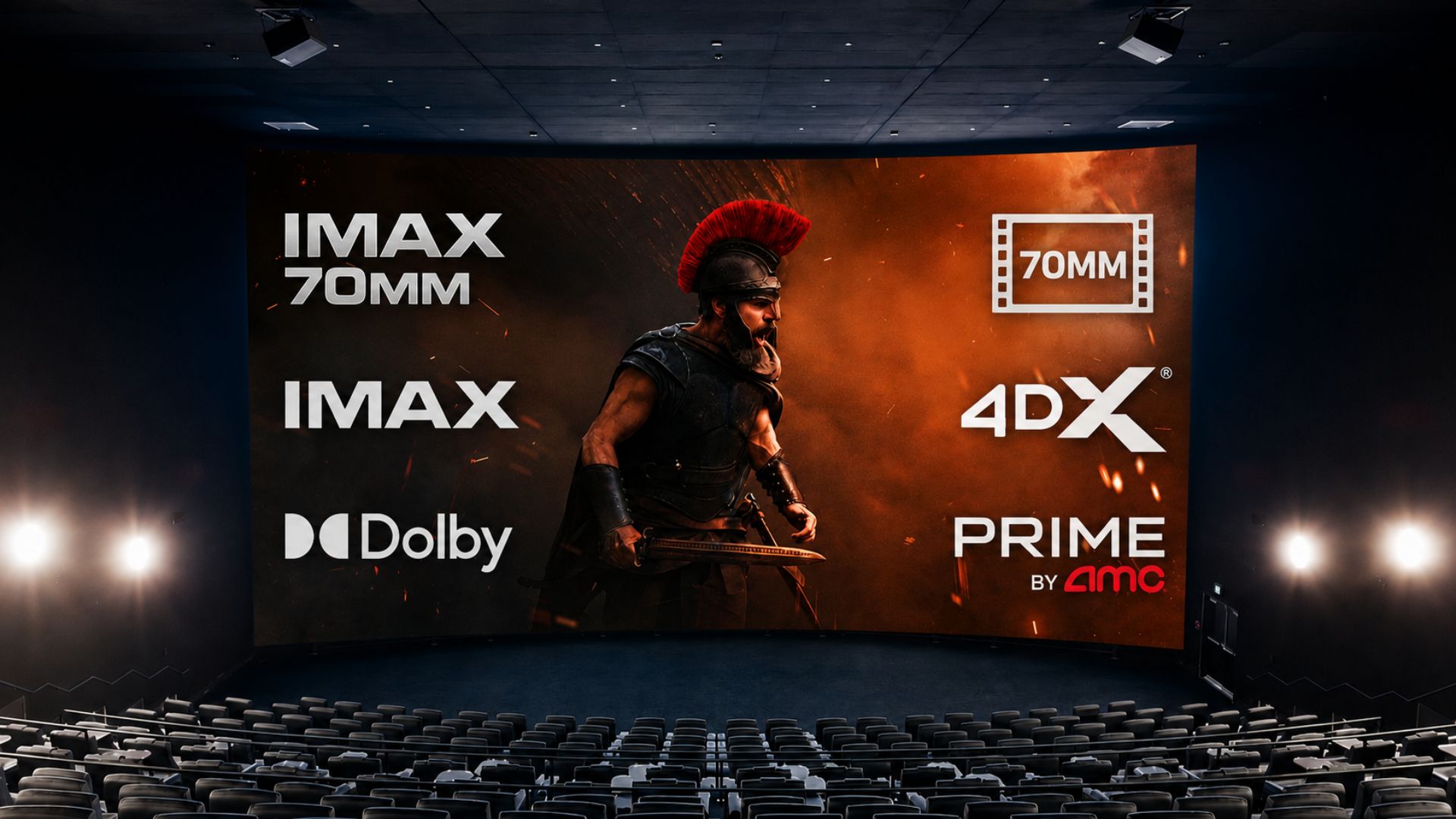
Last updated on 26 July 2026.
Christopher Nolan’s Odyssey is one of those movies where you have to decide between multiple viewing formats. Nolan shot it entirely with IMAX film cameras, but there are many more options. So, this is the format guide for The Odyssey to clear up the confusion.
The Odyssey’s Best Formats RANKED
Since the movie is presented in almost all movie formats available, many viewers are confused about which version to watch.
Movie Theaters advertise premium screens but don’t explain why to choose which one. Even IMAX locations are of 4 different types with differences in screen size, aspect ratio, and projectors.
So, I created a simple ranking for you to easily choose between all of them.
The rankings below consider all these parameters to give you a properly ranked list of the best viewing formats for The Odyssey:
| Format | Aspect Ratio | Why? |
| IMAX 70mm | 1.43:1 | Largest image size and best image quality |
| IMAX GT Laser | 1.43:1 | Largest image size and 4K laser projectors |
| 70mm | 2.20:1 | High resolution with the natural look of film |
| IMAX Laser | 1.90:1 | Larger size than standard screen with 4K laser projectors |
| Dolby Cinema | 1.85 or 2.39 | 4K projectors with superior sound |
| PLFs | 1.85 or 2.39 | Premium projectors with comfortable seating |
| IMAX (Xenon) | 1.90:1 | Larger size than standard screen |
| 35mm | 2.39:1 | Get the texture of physical prints |
| Standard Screen | 2:39:1 | (Your usual experience) |
| 4DX | 2.39:1 | Motion seats and environmental effects |
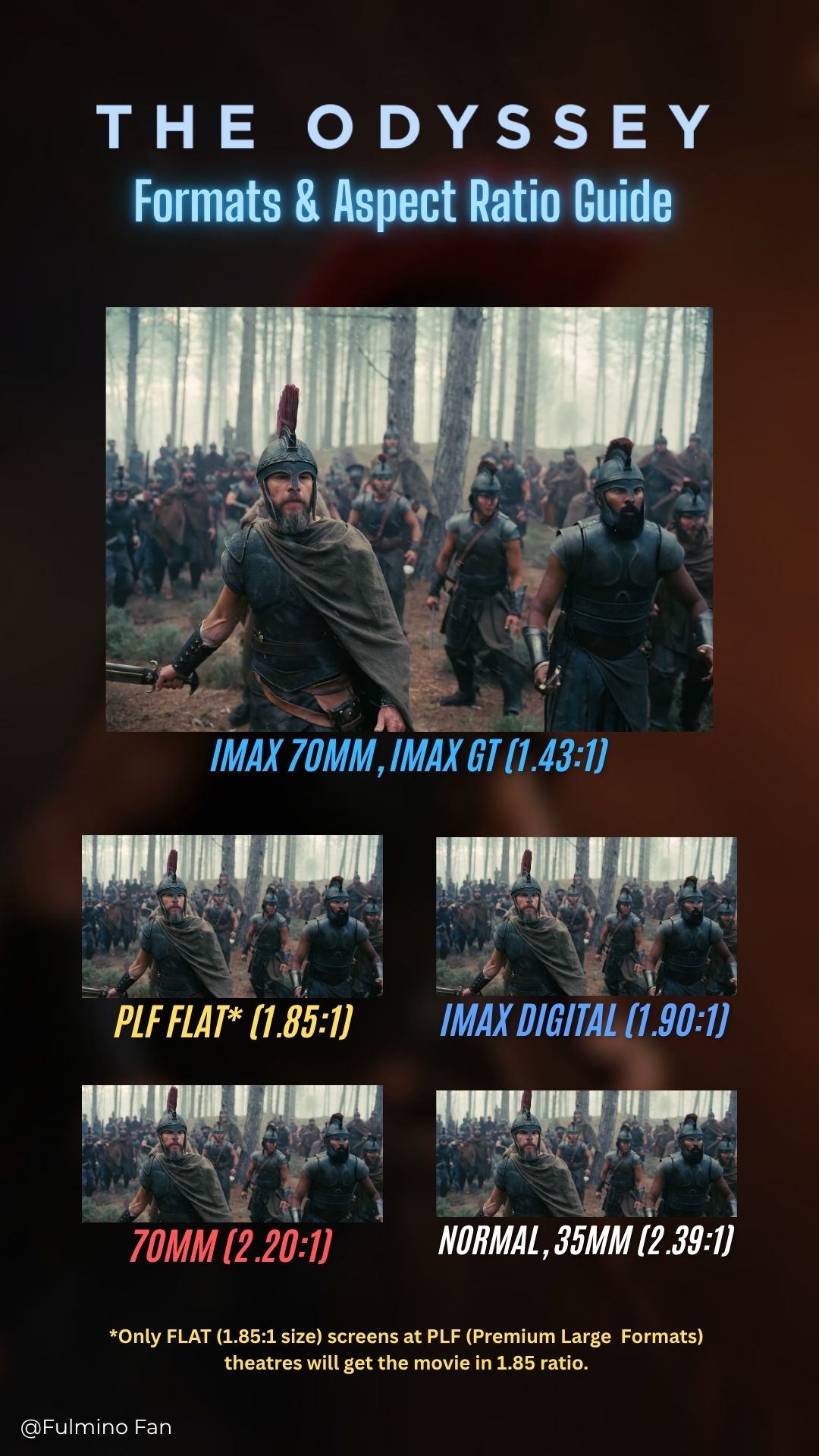
Here are the aspect ratios for all viewing formats for The Odyssey shown in this infographic:
Now, let’s understand what makes each format special:
1) IMAX 70mm
The best format to watch The Odyssey is IMAX 70mm.
The Odyssey is the first movie ever to be shot entirely with IMAX film cameras. When projected on an IMAX 70mm screen, the movie fills the huge 1.43:1 screen, allowing audiences to see the maximum amount of image.
See the difference in this image:
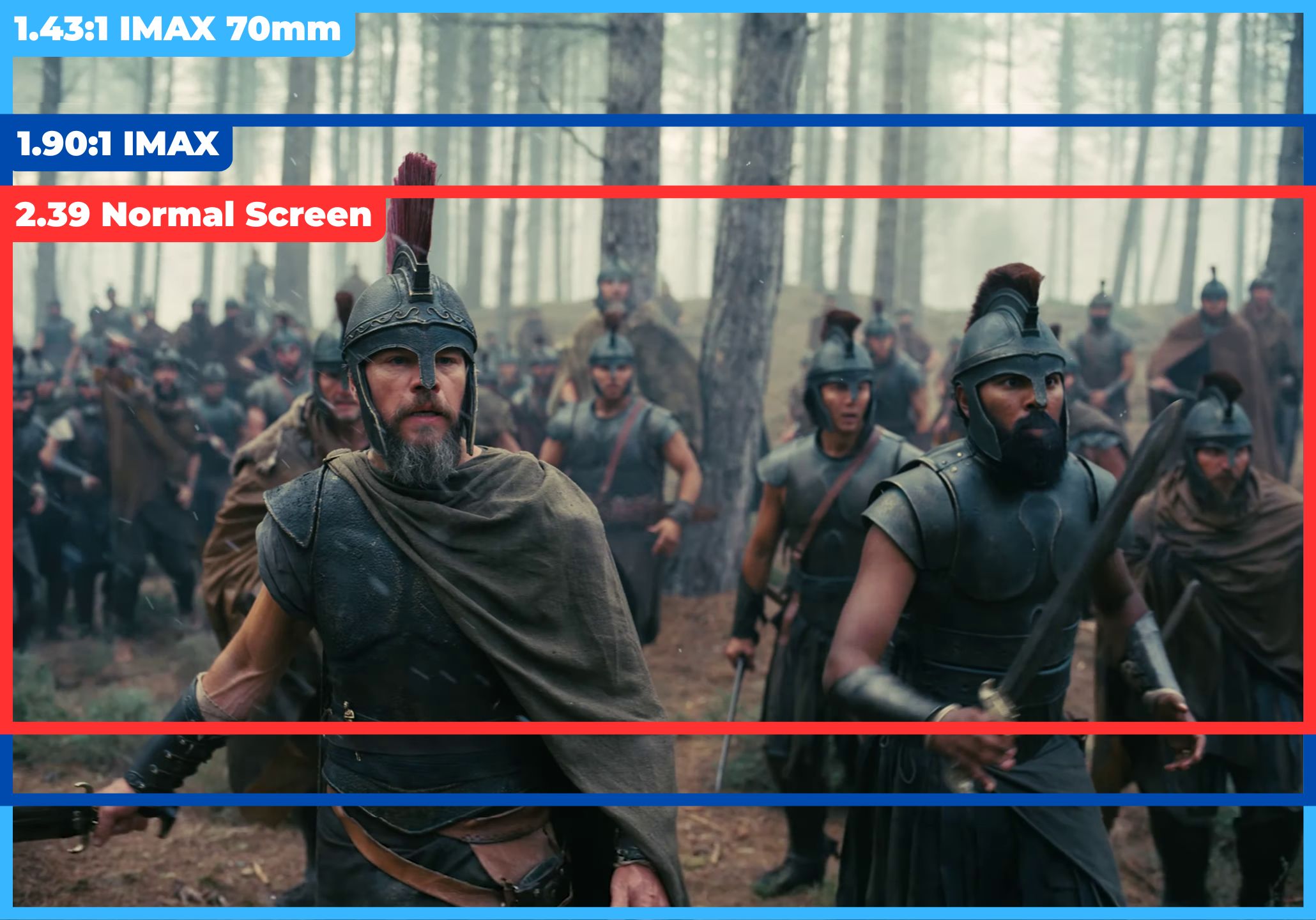
This is the format Nolan designed the movie around.
This is the true IMAX.
Nolan was the first director to bring the IMAX technology to Hollywood. He started with The Dark Knight in 2008 and shot a lot of scenes with these projectors in his filmography, from The Dark Knight Rises (2012) to Oppenheimer (2023).
But he never made a complete movie with it until The Odyssey. So, he made history.
IMAX film cameras are capable of capturing the footage in up to 12K resolution. Nolan used the original film negatives to produce physical release prints, so that this quality remains almost unchanged.
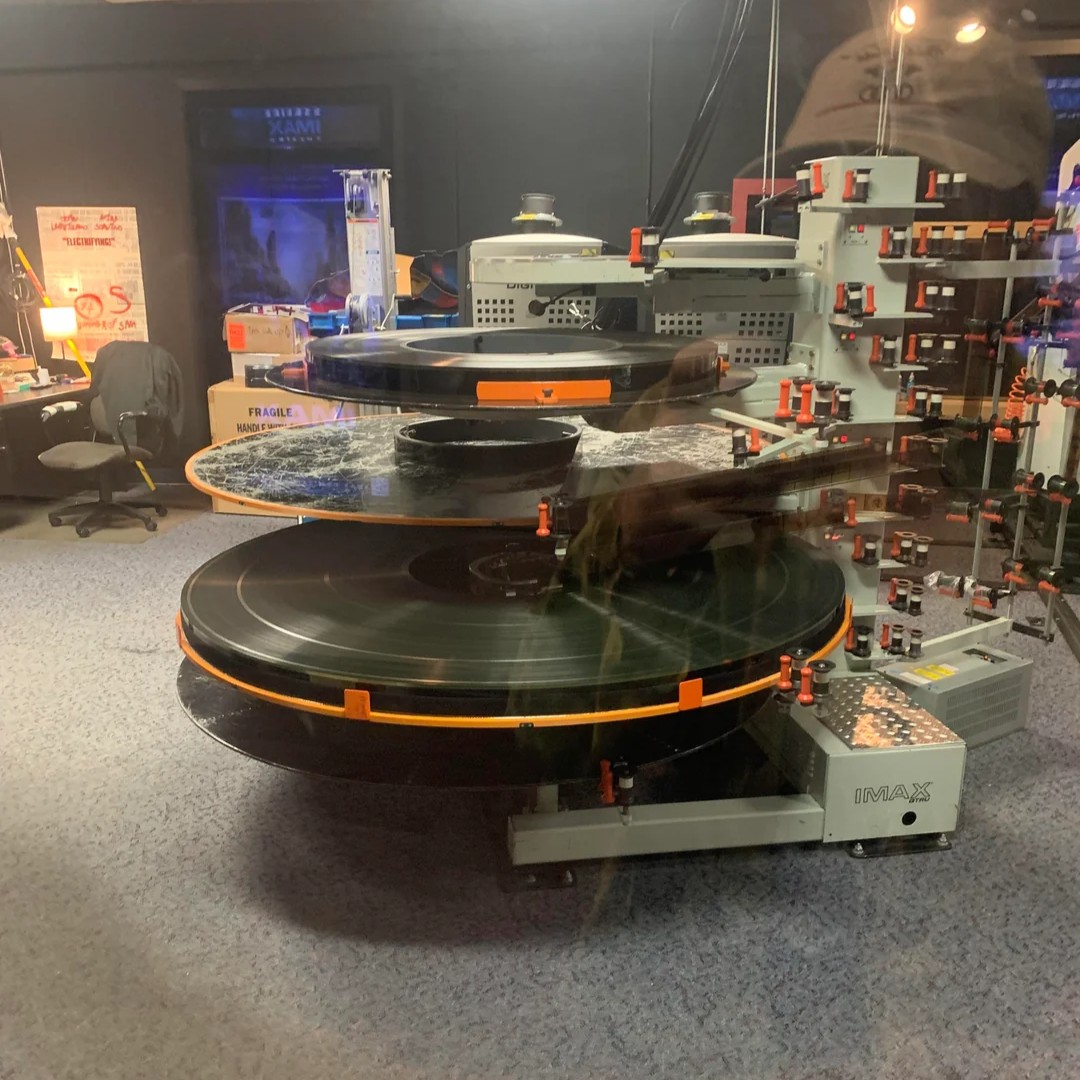
IMAX 70mm screen sizes are also the largest in the world. Many of these screens stretch more than 90 feet wide, although exact dimensions vary by location.
Large landscapes, wide oceans, and natural textures appear more expansive only in the format.
The only problem is that there are only 41 of these IMAX 70mm screens globally, out of which 25 are in the USA, 9 in Canada, 3 in the UK, and a single location in Belgium, Australia, France, and the Czech Republic.
If you live in these countries, check the nearest option from this official list by IMAX:
United States (25)
- Tempe, Arizona, Harkins Arizona Mills & IMAX
- Dublin, California, Regal Hacienda Crossings & IMAX
- Hollywood, California, TCL Chinese Theatres IMAX
- Irvine, California, Regal Irvine Spectrum & IMAX
- Los Angeles, California, Regal LA Live & IMAX
- Ontario, California, Regal Edwards Ontario Palace Stadium & IMAX
- Sacramento, California, Esquire IMAX Theatre
- San Francisco, California, AMC Metreon 16 & IMAX
- Universal City, California, Universal Cinema AMC at CityWalk Hollywood & IMAX
- Colorado Springs, Colorado, Cinemark Carefree Circle & IMAX
- Denver, Colorado, Regal Colorado Center & IMAX
- Fort Lauderdale, Florida, AutoNation IMAX at the Museum of Discovery & Science
- Buford, Georgia, Regal Mall of Georgia & IMAX
- Woodridge, Illinois, Cinemark Seven Bridges & IMAX
- Indianapolis, Indiana, IMAX Theatre at the Indiana State Museum
- Grand Rapids, Michigan, Celebration Cinema North & IMAX
- New York City, New York, AMC Lincoln Square 13 & IMAX
- King of Prussia, Pennsylvania, Regal UA King of Prussia & IMAX
- Providence, Rhode Island, Providence Place Cinemas 16 & IMAX
- Nashville, Tennessee, Regal Opry Mills & IMAX
- Austin, Texas, Bullock Texas State History Museum IMAX Theatre
- Dallas, Texas, Cinemark Dallas XD & IMAX
- Houston, Texas, Regal Edwards Marq’Ee & IMAX
- Richmond, Virginia, Science Museum of Virginia Dome & IMAX
- Spokane, Washington, Riverfront Park IMAX
Canada (9)
- Calgary, Alberta, Scotiabank Chinook & IMAX
- Edmonton, Alberta, Scotiabank Edmonton & IMAX
- Langley, British Columbia, Cineplex Cinemas Langley & IMAX
- Richmond, British Columbia, SilverCity Riverport Cinemas & IMAX
- Halifax, Nova Scotia, Scotiabank Theatre Halifax & IMAX
- Mississauga, Ontario, Cineplex Cinemas Mississauga & IMAX
- Vaughan, Ontario, Cineplex Cinemas Vaughan & IMAX
- Regina, Saskatchewan, Kramer IMAX Theatre
- Saskatoon, Saskatchewan, Kramer IMAX Theatre
United Kingdom (3)
- London, BFI IMAX
- London, Science Museum IMAX
- Manchester, Vue Printworks & IMAX
Australia (1)
- Melbourne, Victoria, IMAX Melbourne
Belgium (1)
- Brussels, Kinepolis Brussels & IMAX
Czech Republic (1)
- Prague, Cinema City Flora IMAX
France (1)
- Montpellier, Pathé Odysseum IMAX
2) IMAX GT Laser
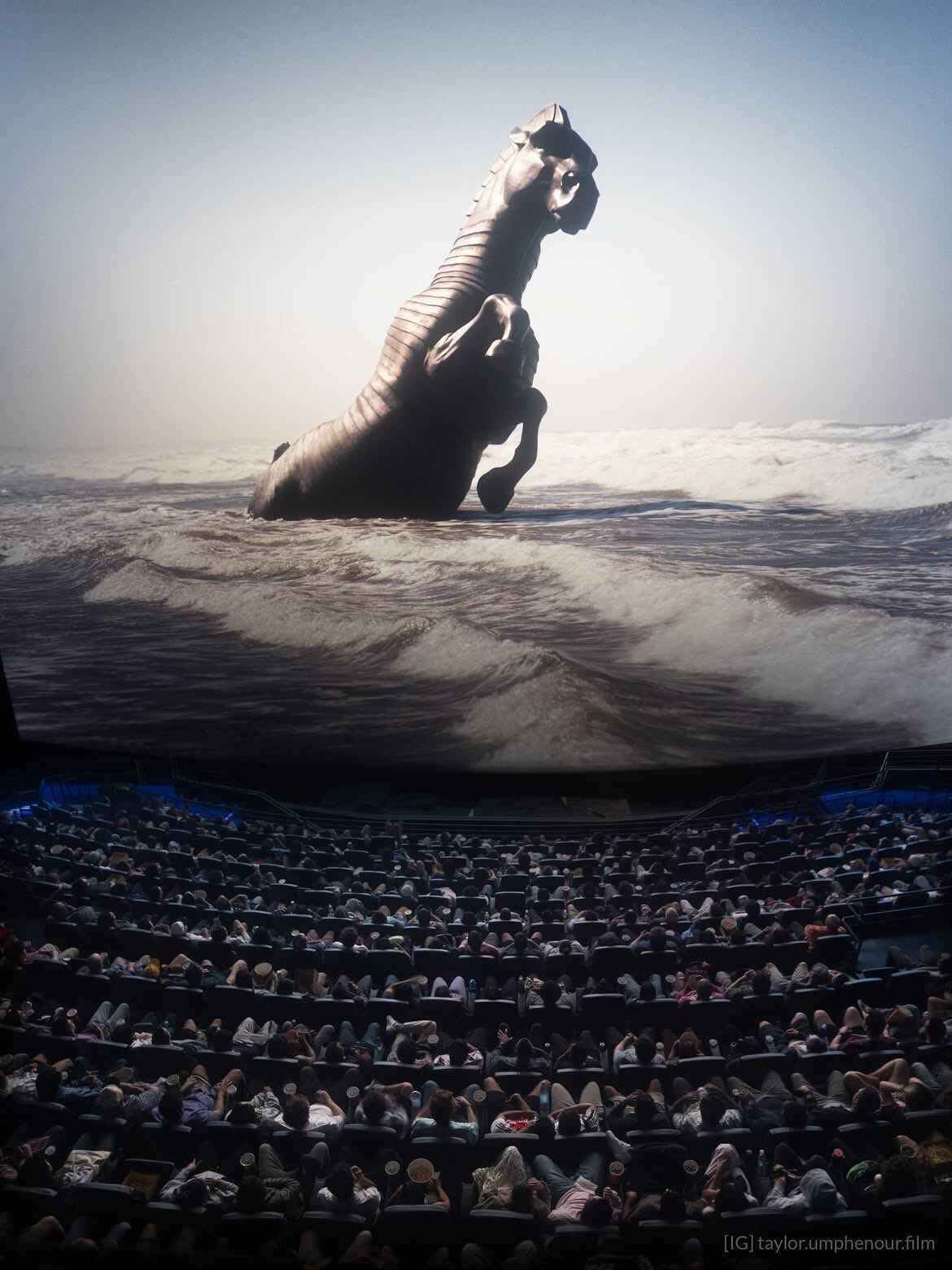
While the aspect ratio remains the same as IMAX 70mm, GT Laser just replaces the film projection with digital projectors.
You will not get the 12K resolution, but you get two of the best 4K laser projectors working together to display the full 1.43:1 image on giant screens.
For The Odyssey, here are GT Laser locations (compiled by: Adam Hlaváč):
United States (7)
- Grand Canyon, Arizona, Grand Canyon IMAX
- Washington, District of Columbia, Lockheed Martin IMAX Theater
- Pooler, Georgia, Royal Cinemas & IMAX
- Reading, Massachusetts, Sunbrella IMAX 3D Theater
- Branson, Missouri, Branson’s IMAX Entertainment Complex
- Austin, Texas, Bullock Texas State History Museum IMAX
- Chantilly, Virginia, Airbus IMAX Theater
Canada (1)
- Toronto, Ontario, Scotiabank Toronto & IMAX
Australia (1)
- Sydney, New South Wales, IMAX Sydney
Taiwan (1)
- Taipei, Miramar IMAX
Germany (2)
- Karlsruhe, Filmpalast am ZKM & IMAX
- Sinsheim, IMAX 3D, Sinsheim Auto & Technik Museum
Mexico (1)
- Monterrey, Mega Pantalla IMAX Papalote Monterrey
New Zealand (1)
- Auckland, Event Cinemas Queen Street & IMAX
Even though it’s digital, I ranked it above the 70mm, because you get the largest image size, and that matters more to most regular moviegoers to have an immersive experience.
Here is what the view looks like in both IMAX 70mm and GT Laser:
3) 70mm
But if you are a fan of physical “film”, don’t miss a chance to watch it in the standard 70mm.
Unlike its IMAX alternative, this format uses 5-perf 70mm film instead of 15-perf. This means you get a 2.20:1 aspect ratio instead of 1.43:1. But you still benefit from the beautiful quality of analog celluloid.
You will get rich colors, with more natural tones, and finer details with a subtle grain.
4) IMAX with Laser
If any of the above two IMAX options (70mm and GT Laser) are not available in your city, then your regular IMAX is still a great choice.
However, even those are not all the same. They can be either IMAX Laser or IMAX Xenon.
Some companies specifically highlight “IMAX with Laser” because it’s the better option. If you can’t find it on the ticketing website, search Reddit or X (Twitter) to find which ones are Lasers and which ones are not.
Most IMAX Laser theatres use a single native 4K laser projector with sharp pictures and excellent contrast. You get deep black levels with HDR-like highlights.
However, the aspect ratio goes down to 1.90:1. This is still more image than a standard screen but not the full IMAX frame captured by Christopher Nolan.
5) Dolby Cinema
Dolby Cinema is the strongest alternative to IMAX.
They focus less on screen size and more on picture quality. Dolby Vision gives you rich colors and deepest black levels in the industry. They support a wider range of color gamut to achieve this.
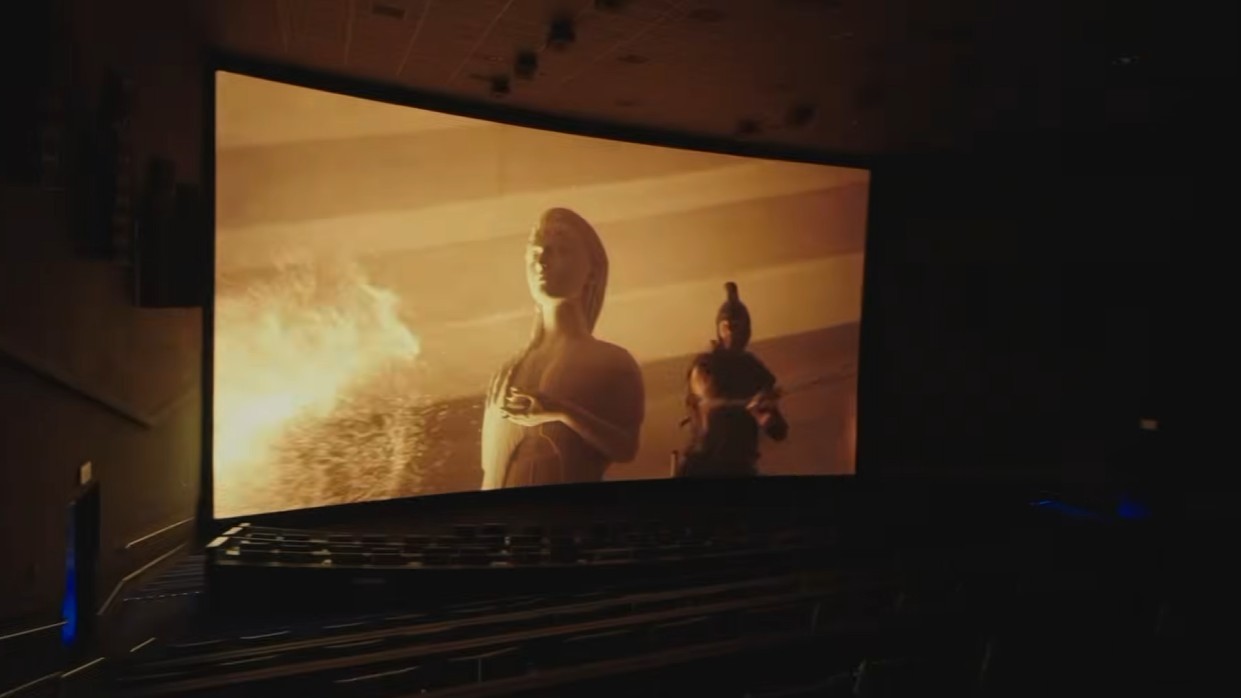
Most of these also have recliner seating and carefully controlled lighting ot make the experience more immersive.
However, not all screen sizes are the same for this format. Some are Flat 1.85:1 while others are the standard 2.39:1.
We recommend choosing a Dolby theater with a 1.85:1 screen because it displays more of the image than a standard 2.39:1 CinemaScope screen.
For the first time, flat 1.85:1 screens, including Dolby Cinema, will also receive an expanded-ratio presentation that was previously exclusive to IMAX.
6) PLF: Cinemark XD, Regal RPX, PRIME at AMC
Other than Dolby, there are many more Premium Large Format (PLF) theatres such as Cinemark XD, Regal RPX, and AMC Prime.
Since all of these are operated by different multiplex chains, there is no specific standardization. What they all promise is premium projectors (mostly 4K) and top-of-the-line sound systems. Those are enough to watch The Odyssey at its fullest.
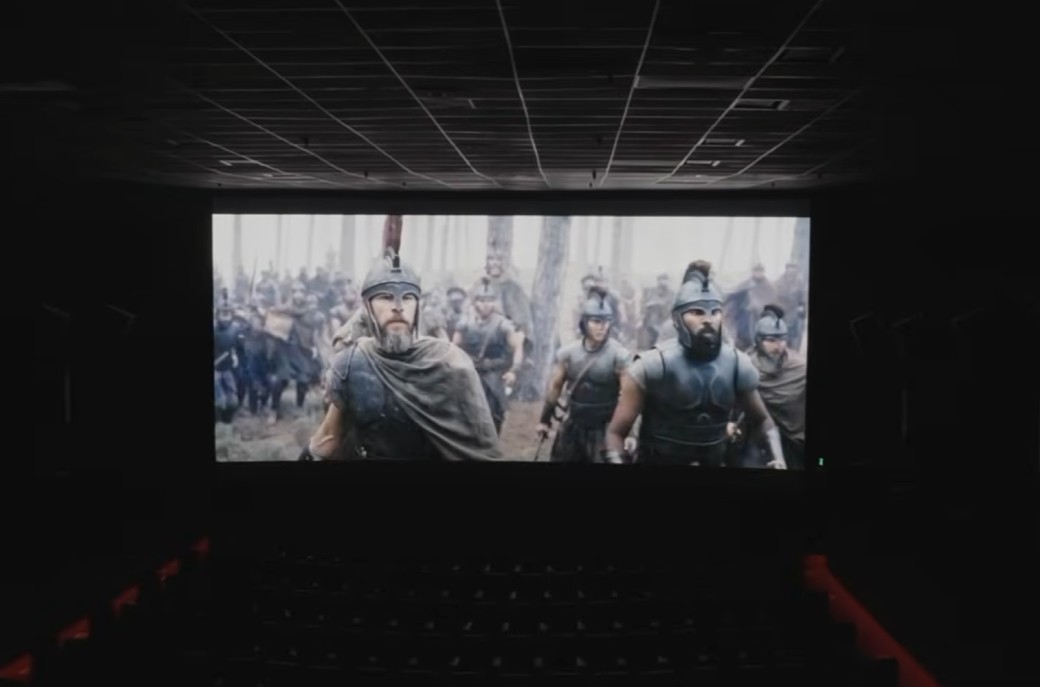
The aspect ratio is also not fixed across all PLF theaters. Some auditoriums use traditional 2.39:1 Cinemascope screens, while others have taller 1.85:1 Flat screens.
7) IMAX (Xenon)
We talked about IMAX with Laser before. If you can’t even find one of those near you, then the IMAX near you is a Xenon one.
They use dual 2K Xenon digital projectors, an older technology before IMAX started their laser projector lineup. So, some theatres still use them and have not upgraded to laser yet.
The picture quality gets diminished, and you may lose out on fine details. But you still get the 1.90:1 aspect ratio, so you see an expanded version of the image nevertheless.
But that does not make it a poor choice. The brightness is still here with powerful sound. I watched it in this format, and the experience was still awesome.
8) 35mm
There’s still one more better option than your standard screen, and that’s 35mm film.
Unlike the two previous film formats (IMAX 70mm and 70mm), this uses a much smaller frame, as you can guess from the name. The image is not that sharp, and the aspect ratio is just the regular 2.39:1.
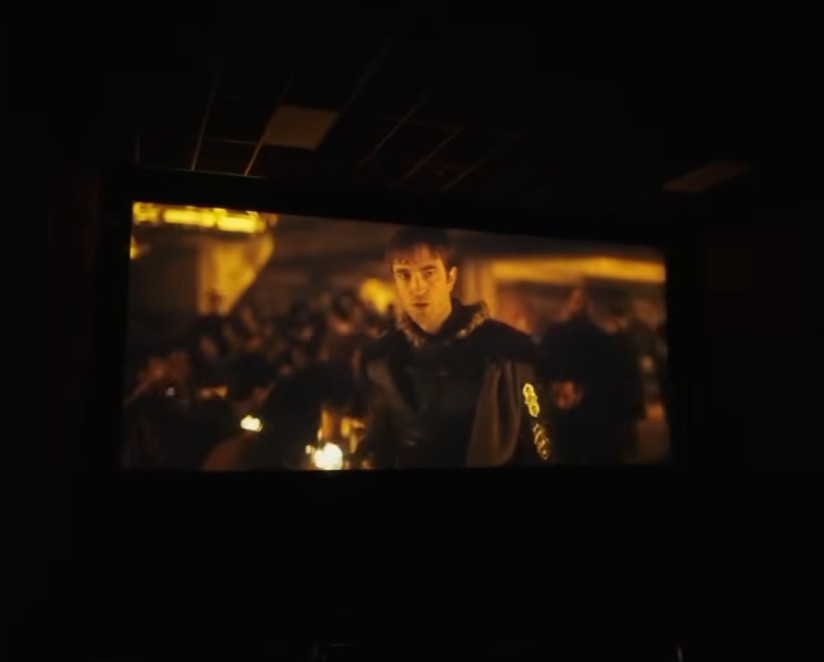
But you get the physical advantage of film grain. This adds a natural warmth that digital projectors can’t match.
While some standard theaters offer 4K digital projection, there is something that feels different about 35mm film. And since The Odyssey was designed to be released on physical film prints, this offers a rare cinematic experience that only a handful of movies still provide today.
9) Standard Screen
If none of the premium formats are available, your standard screen is still a good way because what matters is watching it on the big screen.
Modern multiplexes have improved a great deal in the last decade. You will find that many feature 4K projectors with Dolby 5.1 Sound.
10) 4DX
I am not personally a fan of 4DX, but The Odyssey is formatted for 4DX, so I had to put it here.
Instead of focusing only on picture and sound quality, 4DX adds moving seats, wind, water sprays, scents, vibration, fog, and other environmental effects designed to match what is happening on screen.
So, for a movie that features a lot of scenes with storms and battles, 4DX gives you something that is not available anywhere else. Kids especially enjoy something like that.
However, these things also make the movie more distracting, and sitting on motion-enhanced seats for almost 3 hours is not good for your body either.
Should I watch The Odyssey in IMAX or 70mm?
As mentioned before, these are both different formats with multiple options, ranked in this order: IMAX 70mm, IMAX GT Laser, 70mm, IMAX with Laser, and Standard IMAX.
IMAX 70mm is the best choice because it combines both the grandeur of IMAX technology and the exceptional quality of 70mm.
Then, there is IMAX GT Laser with a full IMAX image but projected digitally.
Then, there is 70mm with a relatively smaller image size while preserving the rich look of physical film prints.
At last, there are regular IMAX screens, either Laser or Xenon, with a bigger aspect ratio than normal theatres.
Takeaways
Now you have the perfect guide for The Odyssey. Nolan filmed the movie entirely with IMAX film cameras, making presentation a central part of the viewing experience.
And if you don’t know who I am? I am Ranish Chauhan a.k.a. Fulmino Fan, and I love Marvel & DC Superheroes and Sci-Fi movies. You can also check my YouTube channel.